Monday, 15 November 2010

where ideas come from: everything is an influence, go out and explore

With reference to the nature v. nurture argument; you are born creative.  You cannot teach creativity, yet there are times when creativity thrives and equally situations where it can be hindered.  I understand the need for determination and commitment when working for an agency, however, the studio is not necessary the place where ideas flow.  I have found the best ideas come when I am out of the office; on the bus, out for a walk or travelling.  Long days spent in the office when ideas become stale with little to spark any new insights you can find yourself rethinking the same ideas over and over again.  The best agencies encourage an exploration of the world; to study your target market, experience the product first hand, visit events and to immerse yourself in culture.  It is as you experience the world around you that the ideas flow and creative breakthroughs are achieved.  To keep ideas fresh it is beneficial to have interests outside of the workplace – it can often lead to interesting insights - which unearth original ideas or provide a unique spin on a concept. 

artwork by author
In philosophy there is a theory, where a man from birth is locked in a room cut off from the world. In the room is only himself and complete darkness.  He only knows what he experiences whilst in the room and therefore cannot speak of or gain knowledge of matters outside.  The theory aims to prove that you cannot create ideas from nothing (ex-halio) rather, you need to experience something in order to have knowledge of, or an opinion on it.  This applies to a creative.  Furthermore, one can only speak of something truly - and form legitimate ideas based on it - if they have experienced it first-hand.  Otherwise, their ideas could be based on false pretences and therefore are rendered ineffective.   When siting within our office all day we are devoid of experiencing truths and insights that can fuel effective, viable ideas and we limit our creative potential.   I believe that if you cannot find an idea by experiencing the world,  then it will never come at all.   When I change my surroundings that is when my imagination and creativity feels most alive, when I am truly aware.  You often view things differently by seeing them for yourself.  
Some may argue that people in the advertising industry can gain knowledge and be kept up-to-date with current affairs and trends through the media, dispensing with the need to go out and explore in order to devise original insights.  However, this gives the views and opinions of others .  This would be a substitute rather than the actual experience.  Encountering something first hand is when originality is born.
An interesting read on the discussed topic is ‘Where Good Ideas Come From’, by Steven Johnson.  The book asks ‘what are the spaces that have historically led to unusual rates of creativity and innovation?’.  

Thursday, 4 November 2010

here today, gone tomorrow

In the Apprentice last night contestants had to create their own pop-up shop fashion experience – the branding of the shops was not great, but nevertheless it occurred to me what genius concepts pop-up stalls are.  Although the idea is that pop-up stalls appear unannounced they involve a lot of planning, a kind of strategic spontaneity, with most appearing in urban areas.  It is an interesting idea, to create a one off experience that’s there for one day only, where customers and brand benefit.  The spaces create a buzz and excitement around a brand and consumers are left with a lasting impression.  Customers feel added value from taking part in an exclusive and unique event, of which most involve free giveaways. 


The pop-up shop concept has many benefits ;
-              a unique experience can be created for the customer
-              they are intriguing with a novel nature and grab attention if branded well  
-              they are flexible on location- you can set up pretty much anywhere  
-              brands can be creative with the empty space
Company Space Buster host pop-up events
Pop-up shops are becoming more popular than ever, Gordon Ramsey in his current TV series this week proposed that his contestants generate a pop-up dining event and Compare The Markets Alexander used the method to promote his autobiography last week.   The stalls can come in a variety of forms such as buses and warehouses and have formed restaurants, hotels, bars & gyms.  Comme des Garçon the fashion label was the first to come up with the idea in 2004, then branded as guerilla stores.

Pop-up shops are similar in idea to Flash Mobs, where large groups of strangers suddenly come together in a public space, perform an act then disperse back into their surroundings.   T-Mobile is a brand who has become synonymous with the concept and the marketing method was also used in Jamie Oliver’s American Food Revolution TV series a few weeks ago.  Flash Mobs initially were a form of performance art but recently are used as a marketing technique.   The term came from Smart Mob, a communication technique which aimed to change the way people share information.   The Pillow Fight Flash Mob is the largest Flash Mob to date, where 25 countries took part in the event, gaining more interest than the London Underground silent disco attempt in 2006.  Germany has banned Flash Mobs referring to them as a form of industrial action.


My favourite thing about both concepts is you feel part of something that few know about, the stir they cause and then their disappearance the next day, almost as if they had never been there.

Tuesday, 19 October 2010

I will play you for it

Drench has devised a concept where their vending machines give you a drink in exchange for a game; an innovative idea that works really well as it links the brand with the user's alertness.  The Drench vending machine is a first of its kind and was available in the UK from August through to Sept.  Thirsty users will have to use their brain in order to be rewarded with a drink.  Forty games have been devised where players interact via. a touch screen, to challenge users’ mental agility.  A nice idea is that those who are unable to access a machine can play online at http://www.4pockets.com/drench/The concept successfully proves a brand benefit; that users perform better when hydrated.  Due to the fun concept and addictive games the machines ensure consumers are engaged.    


It occurs to me that this is not the first time a brand has used vending machines with an unexpected twist.  Another good example is Smart’s vending installation which contained a full-sized car.   


Unfortunately, the machine only dispensed promotional material. I think a nice angle would have been if it dispensed a key ring model of the car or, alternatively, if a user correctly guessed a unique code, they win the car.  There are some further unusual examples of vending machines, which can be found here http://bit.ly/bLEUA4.  Vending machines can sell unexpected products such as; jeans, wine, board games, books and Nike soccer balls.  I think Drench and Smart have proved how successful such a marketing method can be.  These innovative machines create brand awareness and are a great way for consumers to interact with a brand whilst retaining a memorable experience. 

Saturday, 16 October 2010

Is there such a thing as good design?

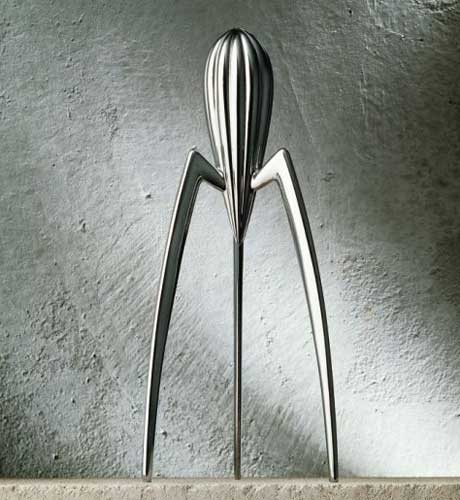
A friend recently purchased Philip Stark’s lemon juicer.  It’s an example of an object  that appears to be  good design due to a slick appeal, even proportions & shape and shiny finish.  It would be good to have on display in the kitchen.  However, the design is flawed in several ways; it fails to stand, acid from lemons erode the metal coating and the juice does not flow directly into the glass.  Good design should not only be aesthetically pleasing it also has to be of benefit to the user.  As shown in the Stark example what is the point of design that does not work?

It is quite easy for us as designers to get caught up in the world of beautifully designed things, with font, layout pads and vast colours.  However, designers have more power than they realise , they have the power to evoke change as can be seen in the success of Coca Cola.  The brands success is not due to its graphic design, but rather a history of clever marketing,  1.2 billion times a day someone reaches for one.  In Tanzania, a country battling disease, corruption and poverty, every city and village is branded with the Coca Cola logo.  This is branding at its most powerful, but is it good design?  Surly it would be better if designers used their power to enforce ideas that could shape people’s lives and force a change for good.  Interestingly, the price of a bottle of Coca Cola is the same as an anti-malaria pill.


One argument is can designers ever produce good work?  A designer may invent a design that functions well and looks visually appealing but what if it is designed for an unethical company?  Does that make the work tainted?   However, it can be argued designers are just doing their job at the end of the day.    I think it is up to the designer to access this ‘aspect’ of good design as they see it.
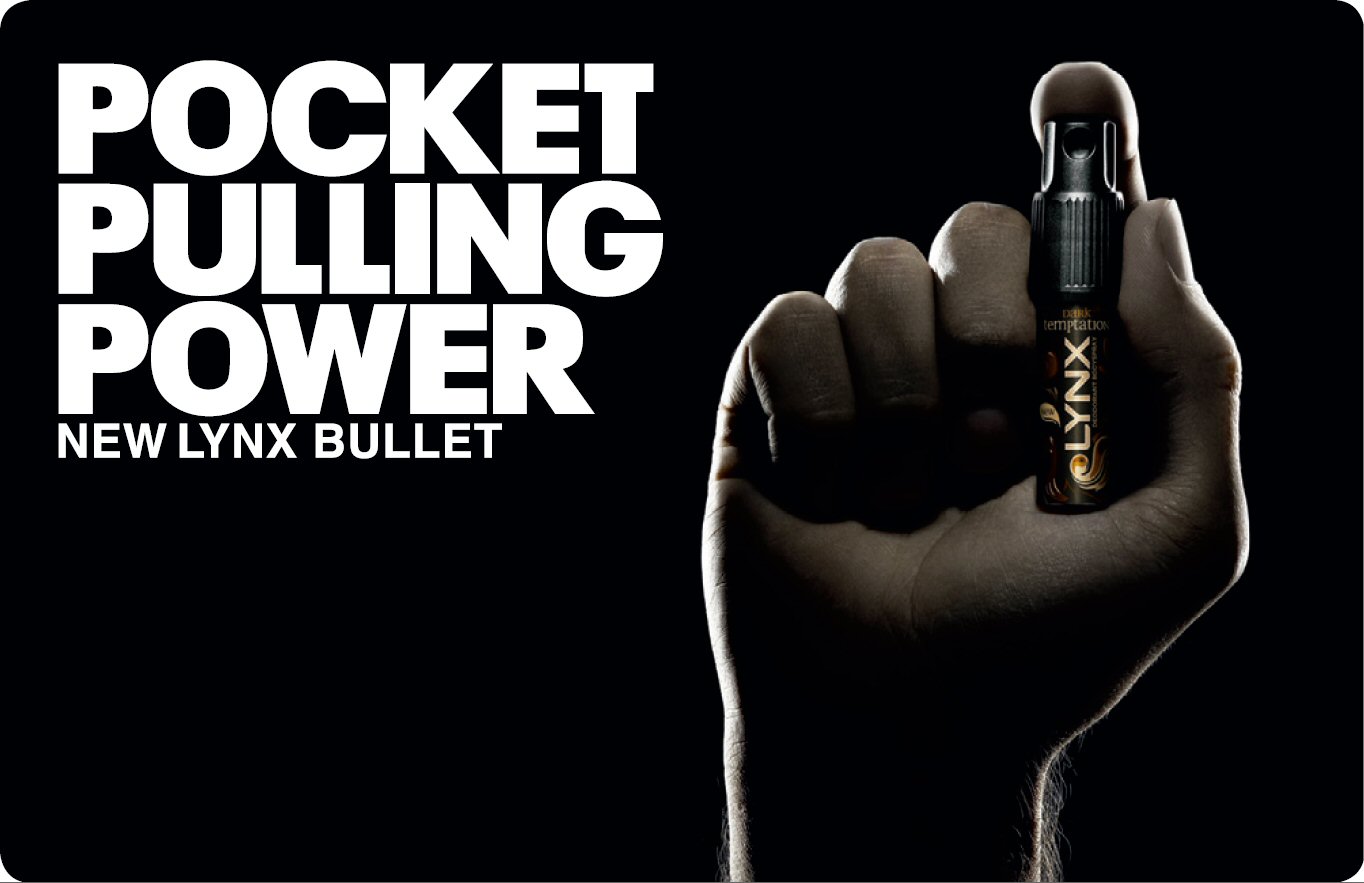
In the world of design where manipulation and exploration is at the heart of work, one wonders if design can ever be ethical.  Designer’s design messages  and images that cleverly deceive people.  Such as Baileys liquor which showcases Celtic imagery on the label, conjuring images of tradition, when in fact it was invented in 1974.  This is misleading design.  The truth is bent in most adverting so are all ads. unethical?  The Lynx guy who gets all the girls or the Special K bar that gives you a slim figure.  It can be argued however, that we as consumers have the power to decide whether we need something or not.  This can be tricky though when a designer creates a need and want for a product.  Surly, good design should be about the product not what is vulnerable in the buyer.

I believe not all design is unethical.  Good design can change lives, promote innovation and  entertain.  For me good design is that which solves problems and creates a positive change.  Sometimes the most successful designs solve the simplest of problems such as the vegetable peeler or the Lifestraw (a water filtration device, used in countries where it’s hard to find clean water).  I also think good design is that which is sustainable.  We as designers have a duty to not only create eco products but also send out the message that we need to act more sustainable. 

It is important that design looks appealing as it needs to catch our eye, but it needs to fulfil a purpose and in a non-manipulative way.  It also needs to be sustainable and enforce change.  For me this is good design a mixture of elements.  This topic fascinates me which is why I have chosen it for my dissertation topic.  I often wonder if there can be such a thing as ‘good' or ‘bad’, I think philosophy and design are heavily linked.  That question is for another blog entry.          

Thursday, 14 October 2010

A new breed of billboard

I came across an interesting idea today - currently at concept stage - for the proposed ‘Audi Spectacle’ campaign.  The idea is to suspend four life size Audi’s inside the silver rings that create the Audi logo from iconic bridges and juxtaposed by other famous landmarks such as Sydney Harbour.


The installation builds on Audi’s aim; to avoid merely blending in with the ordinary.  They achieve this by making their presence known against iconic landmarks and in doing so exuding the brand's confidence.  As an innovative company, it seems apt that they create a concept for a new breed of ‘billboard’.

The launch will feature at night with an event created around the installation unveiling which will include a live symphony orchestra (also suspended) and fireworks. 


This unusual idea of the campaign is not to create media attention by the actual displays of the cars, but rather the anticipated build up leading to the event and the journey of creation and installation.  Before the launch goes ahead the company want to see what people think about the idea.  It is surely worthy of discussion; a refreshing idea that will certainly grab attention.